

My Approach
How I understand people—and how that shapes the work we do together.
A Systemic and Relational lens
I believe that your thoughts, emotions, and nervous system make sense within the relationships and systems you’ve lived inside of. Nothing exists in a vacuum—your feelings, distress, and behaviors are shaped by context, connection, and survival needs. I’m always holding the larger picture of how family dynamics, identity, culture, power, and lived experience have shaped the way you relate to yourself and to others.
This perspective helps reduce shame about and honors the adaptive patterns and strategies that helped you stay connected, loved, or survive, while also learning and practicing new ways of being and relating that move you towards a more vibrant and full life.
In a nutshell, we learn how to say “thank you, next” to whatever you decide is no longer serving you well.
thank you, nextWhat sessions with me feel like
That systemic and relational lens doesn't mean we're always looking at everything from the same distance.
Therapy is an ongoing process of adjusting the focus. Sometimes we zoom out to understand the the broader context of your experiences. Other times we zoom in to explore what's happening right now in the present moment.
Moving between these points of view helps us stay grounded and focused on your goals, without getting overwhelmed by the big picture or too ~lost in the sauce~ of any one perspective.
Bringing your world into focus
No single theory can fully capture the complexity of the human experience. That's why I draw from a variety of evidence-based approaches rather than relying on just one perspective.
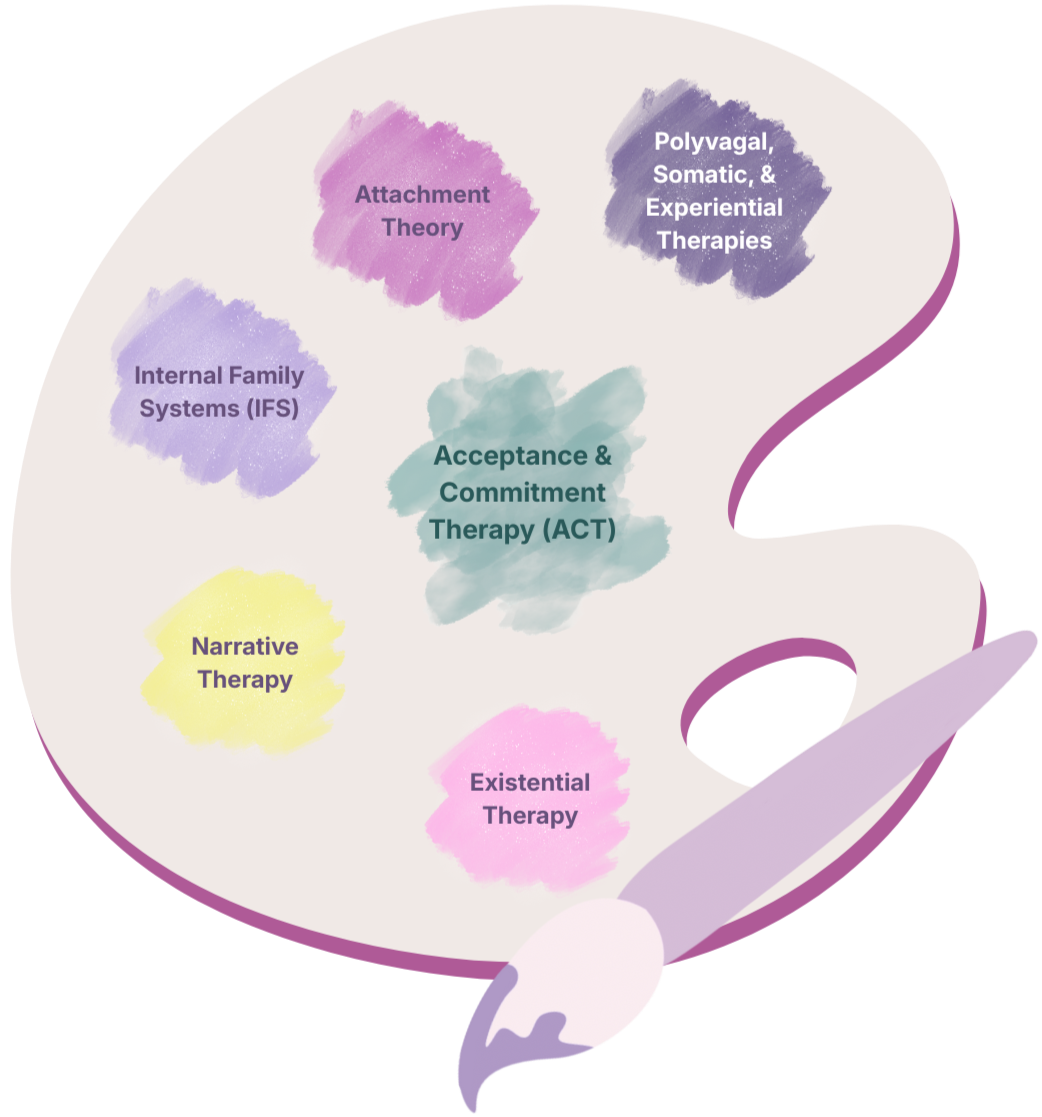
Think of them as the lenses I wear that help me make sense of things. Much like prescription eyeglasses bring blurry details into focus, these foundational lenses help me better understand you, your relationships, and the world you move through.
The goal isn’t to fit you into a theory, it's to use the right lens at the right moment so we can better understand what you're experiencing together.

My toolkit
As we oscillate between zoomed-in and zoomed-out perspectives, I anchor our work in well-researched, clinically supported theories and approaches, including but not limited to:
Acceptance and Commitment Therapy
Relational-Cultural Theory
Internal Family Systems (IFS) Therapy
Relational Therapy
Polyvagal Theory
Attachment Theory
Emotion-Focused Therapy
Somatic Therapy
Narrative Therapy
Systems Theory
Emotion-Focused Couples Therapy
Developmental Model of Couples Therapy
Gottman Method
Dialectical Behavioral Therapy (DBT)
Cognitive Behavioral Therapy (CBT)
Solution-Focused Brief Therapy
Experiential Therapy
Existential Therapy
I use my toolkit thoughtfully and collaboratively based on what feels most supportive for you. Much like a whisk wouldn’t be your tool of choice when tasked with hanging a picture on the wall, not every theory is going to be well-suited for the work we’re doing together!
Licensed Professional Counselor Associate (Texas, #97766)
M.A. in Professional Clinical Counseling
Supervision by Stephanie Van Fossen, Certified Sex Therapist and Licensed Professional Counselor Supervisor
Ongoing training in trauma, polyvagal, identity-affirming care, and more.
Let’s be real. This info is both important and, perhaps, a little boring. I’ve done my best to keep it short and sweet.
Credentials & training
I also believe in doing my own work
I know firsthand what it feels like to sit in the client’s chair and have your raw, tender, messy humanness witnessed and held. You won’t be judged or rushed through these moments, we’ll give them the time, space, and tenderness they deserve.